



 News
News
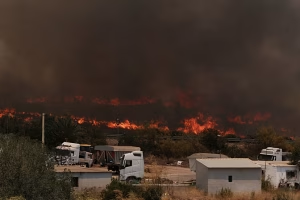
The wildfires that broke out over the past week in France and Spain, which have already burned more than 115,000 hectares and forced over 320,000 people from their homes, have stood out for the sheer violence and scale of the flames. The French authorities admit that it may take months to extinguish them.
They are the latest examples of what the operational and scientific community has, since the second half of the 2010s, come to describe as “sixth-generation fires”, especially after the blazes in Pedrógão Grande in Portugal (2017) and in Greece (2018), each of which claimed more than 100 lives.

This new pattern first became more evident in Europe, although it was also identified in 2017 in Chile, where it returned in an even more devastating form in 2024, a year in which 137 people lost their lives. These same characteristics have also been observed in other parts of the world, notably in Australia (2019–20), on the west coast of the United States (2020) and in Canada (2023).
The major shift in fire behaviour is being driven by climate change, explains Domingos Xavier Viegas to Euronews, a professor at the Faculty of Science and Technology at the University of Coimbra (FCTUC) and a specialist in rural fires. With higher temperatures, less rainfall and lower levels of humidity, the soil and vegetation become drier, greatly increasing the “conditions for ignition” and the “area available to burn”.
What sets a sixth-generation wildfire apart?
The destructive potential of these megafires stems from the energy they release, which can alter the weather conditions around them and exhaust traditional firefighting resources, however robust these may be.
When more than ten megawatts (MW) per metre are being released, the fire can no longer be put out through the direct action of firefighters, Xavier Viegas explains. “If we translate that into flame length, a front that is releasing ten MW will have flames roughly ten metres high,” he adds.
“What is happening is that, nowadays, we sometimes have fires which, in certain phases of their spread, reach intensities three, four, five, even six times higher. In other words, it is impossible to fight flames that can be up to 60 metres long,” the specialist notes.
A thermal load of this magnitude makes these fires self-feeding, so they cease to be just a phenomenon controlled by the local atmosphere and begin to influence it as well.
Exceptionally dense smoke clouds form, carrying enormous heat, changing wind direction, producing electrical discharges and hurling embers several kilometres ahead, which in turn ignite new fires.
Out of season and in unusual locations
Sixth-generation wildfires are occurring more and more often and, in the words of the University of Coimbra expert, “they are not an isolated summer event”. Take the case of Pedrógão Grande, nine years ago, where the flames first broke out in June, still in spring, and later in October, already in autumn.
They are also happening across an “ever wider geographical area”, says Xavier Viegas. “In Portugal, such fires used to occur in the north and centre, and now they sometimes also appear on the coast and in the Alentejo, in regions where they were less common.”
The same trend can be seen in the rest of Europe, where fires are no longer confined to the south: in recent weeks, central and northern countries such as Germany, Switzerland and Norway have been struggling with wildfires.
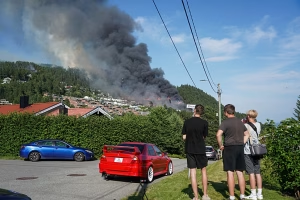
This is a “global phenomenon” that calls for an “integrated” approach, including to prevention. “Even tourists need to be aware of this,” stresses Xavier Viegas, referring to the recent fire in Almería, in south-eastern Spain, which claimed 14 lives, 12 of them foreign nationals. “They were not familiar with that reality,” he underlines.
How can these fires be fought?
Ground resources and even the heaviest aircraft cease to be effective in stopping the front of a sixth-generation wildfire. To protect people, property and infrastructure, the FCTUC specialist recommends attacking the fire from the rear or from the flanks.
Firebreaks can be created by using “some natural feature that may exist, for example a river or an area without vegetation”.
Another strategy is to open up a strip of land by “cutting the vegetation with tracked machinery” or to widen that strip “with the help of a backfire”, something that “only the authorities can do”. However, this operation becomes risky if the wind is strong, as has often been the case.
“Sometimes an ember projection jumps that barrier and, as it were, all the effort goes down the drain,” he stresses.
In such circumstances, Xavier Viegas warns, pragmatism is needed to avoid tragedy. “In general, people expect firefighters to put out any fire, wherever it may be, and they do not realise that there is a part of the fire that cannot be suppressed. We should not want firefighters to risk their lives, not least because it is a hopeless fight.”
These fires are particularly devastating in forests because of combustible material such as “vegetation and trees”. When they reach more urban areas, “they no longer have the same spread characteristics, and there houses and buildings can be safe places for people”, he says.
Evacuating residents to built-up residential areas is therefore a solution that should be considered.
“There are certain houses and buildings which, even if they were hit by a fire of this intensity, might be able to withstand it and serve as a shelter,” he concludes.