



 News
News
Ukraine is now said to be producing around 500,000 drones a month to defend itself against Russia’s full-scale invasion. That’s according to Ukrainian media, which also report that this output has almost doubled in the space of a year. But the sheer number of drones is not decisive for the Ukrainian army: the unmanned systems are being upgraded and adapted almost every week.
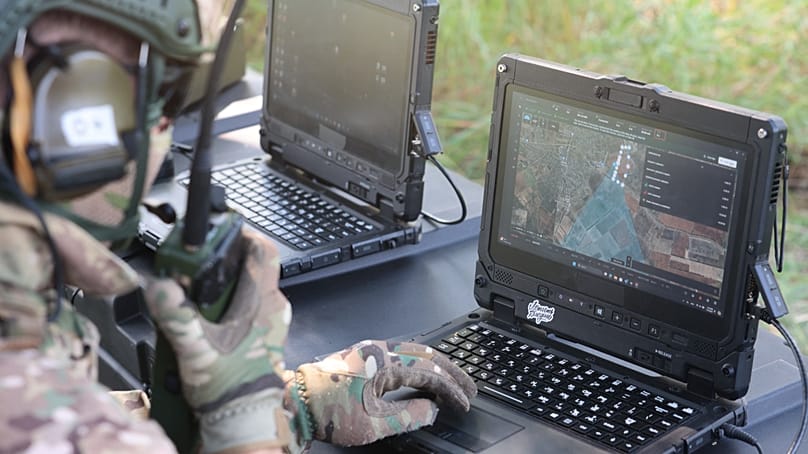
One of the companies driving this ongoing drone revolution and evolution is the Ukrainian firm Buntar Aerospace, which has added a new feature to its Buntar Copilot software, allowing reconnaissance drones to be controlled entirely remotely. It means only a small team remains at the launch site, while missions can be run from hundreds or even thousands of kilometres away.
“The main goal is to ensure the safety of experienced crews. Once the drone is airborne, the pilot can carry out the mission from a safe location while the launch team quickly leaves the area,” Bohdan Sas, one of Buntar’s founders, told Euronews.
Unlike other firms, Buntar does not rely on external remote-desktop software but has built it directly into its own mission-planning platform. The reason, Sas said, is simple: “Warfare has changed, and remote control has now become an indispensable standard.”
How quickly innovation can advance in war
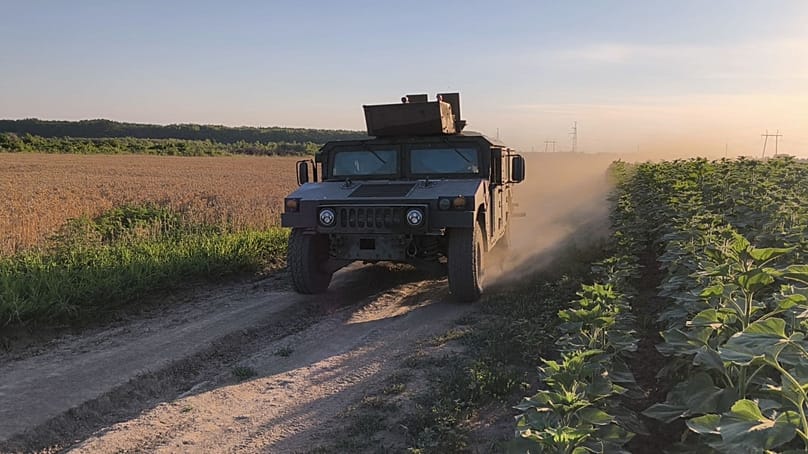
Not only do soldiers have to adapt to the realities of war; systems do too, as the example of Kaban shows. The Ukrainian company Kaban Robotics converts existing vehicles such as the US HMMWV (High Mobility Multipurpose Wheeled Vehicle, better known as the Humvee) so that they can be operated remotely from a safe distance.
The advantage is that rather than designing an entirely new unmanned vehicle, existing hardware can be adapted relatively quickly for new tasks. The pace of further development is even more striking. According to the system’s lead developer, new functions are introduced directly in response to feedback from Ukrainian soldiers.
In one case, soldiers suggested as a vehicle was being handed over that the exterior lights should switch off automatically if communication was lost. The modification was implemented in around 15 minutes.
The cameras too were adapted straight from frontline experience: because oncoming headlights could dazzle the main camera at night, a function was added enabling the driver to switch to the thermal-imaging camera at the push of a button.
As Kaban told Euronews: “Sometimes the time between a suggestion from military personnel and the implementation of a new feature is not measured in months or weeks, but literally in minutes.”
Is the Bundeswehr adapting to modern warfare?
Drones also play a major role in the German armed forces. Germany is now trying to ramp up industrial production. A few months ago, the Bundestag’s budget committee approved, with conditions, the delivery of thousands of so-called “kamikaze” drones for the Bundeswehr. These are relatively inexpensive systems designed to engage individual enemy targets precisely over long distances.
Germany may not yet be producing as many drones as Ukraine, but output has been ramped up sharply. Bavaria in particular has become a hub for numerous drone manufacturers, including Quantum Systems, Helsing, ARX and Airlogix, which have reportedly begun mass production of more than 5,000 long-range combat drones for Ukraine. And Bavaria is not set to be the only site: according to a report in the newspaper Welt, another production facility is already planned in eastern Germany.
In last year’s report by the parliamentary commissioner for the armed forces, Henning Otte, he wrote that “the armed forces are, however, lagging far too far behind in the acquisition of modern unmanned systems.”
During a troop visit, criticism was voiced that the KZO and LUNA drones were already outdated when they were introduced. The priority now, he argued, is to get new systems “into series production quickly” and deliver them to the troops in large numbers.
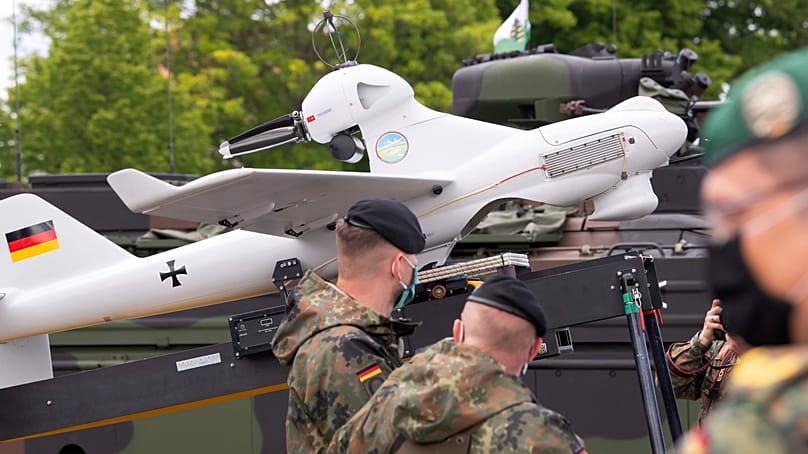
The problem, however, is not just production. Otte also criticises the Bundeswehr’s procurement processes as overly bureaucratic. In his view, more money on its own is not enough. He writes that the “blanket invocation of underfunding of the Bundeswehr” is no longer an excuse. Instead, procurement needs to be accelerated and the forces relieved of “non-military bureaucracy.”
When it comes to drones, security expert Dr Frank Sauer therefore sees technology as the lesser problem. “Catching up and closing the gap is quite possible here and in fact already under way, albeit at much higher prices per drone, which is why German products are not particularly popular in Ukraine,” he told Euronews.
“The real issue is how we handle these new systems, internalise the changed geometry of the battlefield, and develop new tactics and procedures along with the organisational ‘muscles’ that go with them. I fear we are still too wedded to the old ways and not learning fast enough.”
Freuding: ‘Everyone must learn it, everyone must be able to do it’
Lieutenant General Dr Christian Freuding told the RND news platform in an interview that basic training already includes an introductory course in operating drones.
“Everyone must learn it, everyone must be able to do it,” said Freuding, emphasising that every soldier has to be a drone reconnaissance operator or a counter-drone specialist.
For the German armed forces, the challenge therefore lies not only in procurement but also in their ability to adapt and learn from current conflicts. How far the Bundeswehr is adjusting to the new form of warfare could be seen at this year’s “Freedom Shield I” exercise in Lithuania: soldiers had to fly drones themselves and protect against them using improvised drone cages of their own design.
Kevin, a tank commander from Augustdorf-based Tank Battalion 203, told Euronews after the exercise that it was the first time he had flown a drone. Learning how it worked took three minutes, he said.