


 News
News
Fermented fish, cheese with maggots, black pudding or offal: across Europe’s kitchens there are specialities that can make even seasoned gourmets recoil at first. Yet disgust is subjective. What is seen as a time-honoured delicacy in one country raises eyebrows elsewhere – or even prompts a physical rejection. The Disgusting Food Museum in Berlin shows visitors just how narrow the line between disgust, curiosity and culinary tradition can be.
The concept originated in Malmö in Sweden; the museum has also been open in Berlin since 2021. The exhibition does not just aim to shock, but to explain why people react so differently to food.
“We want to show that disgust is something that affects all of us. And that it is culturally conditioned, but also rooted in evolutionary biology,” says museum director Alexandra Bernsteiner. “And we do that with something we ideally do three times a day: eating.” The museum therefore also sees itself as a place for a change of perspective. The aim is to dismantle prejudices and bring different cultures, but also different perspectives on food, closer together.
Disgust is culturally learned
Almost 100 unusual foodstuffs from around the world can be admired at the Disgusting Food Museum, where visitors are invited to confront their squeamishness.
Our disgust response is often triggered by smell, texture, appearance or by knowing how a product is made. At the same time, the feeling is culturally shaped: what repels some people is an everyday food – or even a source of culinary pride – elsewhere. This is precisely where the museum comes in. It shows that food always carries identity, memory and a sense of belonging.
And disgust also protects. According to Alexandra Bernsteiner, that first reflex is often the body’s warning signal. At the same time, it can change through familiarity, knowledge and context.

Germany: hearty fare with disgust potential
Germany, too, has its culinary borderline cases. One example is bread soup, a simple dish made from stale bread and stock, often refined with onions and fat. What sounds like a way of using up leftovers actually stands for a long tradition of frugal cooking.
Far more striking is mite cheese from Saxony-Anhalt. In this speciality the cheese matures with the help of cheese mites, whose droppings create the characteristic aroma. To outsiders that sounds like a culinary nightmare; in the region, it is associated with craftsmanship and tradition. Jellied meat, or Sülze, also falls into this category: pieces of meat are set in aspic or jelly, and the wobbly texture can quickly cause irritation. Saumagen from the Palatinate, meanwhile, is a hearty mix of meat, potatoes and spices cooked in a pig’s stomach. It is precisely this casing that initially puts many people off, even though the dish is firmly rooted in the region’s cuisine.
Italy: the cheese that is alive
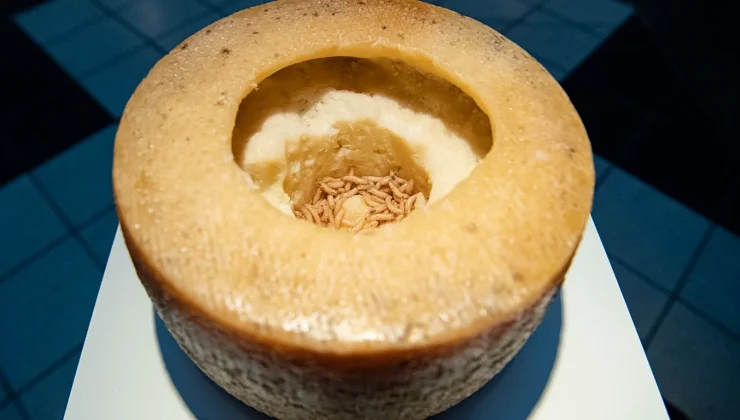
Italy is home to Casu Marzu, perhaps Europe’s best-known disgusting dish. This Sardinian cheese is deliberately infested with fly larvae, which further ferment it. The maggots are often eaten along with the cheese. The result is a very soft, intensely smelling pecorino that many find off-putting, but which is regarded locally as a delicacy.
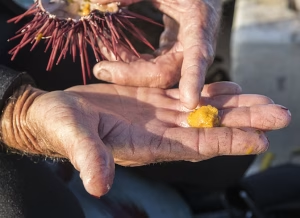
Sea urchins from southern Italy fit this pattern too. Especially in coastal regions they are opened fresh and scooped straight from the shell. Their raw, intensely marine flavour and unfamiliar texture make them a test right on the disgust threshold for many people. For gourmets, that is precisely where their appeal lies.
Sweden: when smell is the challenge
Sweden is represented by surströmming, the notorious fermented herring. The dish is known above all for its overpowering smell, less for its taste. Even opening the tin is seen as a test of courage. In Sweden, surströmming is a traditional food; abroad it is often a full-on assault on the senses. At the Disgusting Food Museum in Berlin, a fresh tin of surströmming is opened once a month for particularly brave visitors.

France: a sausage with character
France, the land of haute cuisine, also has specialities that are not to everyone’s taste. One particularly striking example is andouillette. This coarsely textured sausage contains offal, usually pork intestines and sometimes stomach, and is famous for its pungent smell. In regions such as Troyes or Lyon it is part of classic local cooking.
Poland: blood, broth and sourness
Poland, too, has dishes that can cause bewilderment outside the country. The best-known is probably kaszanka, a groats sausage with buckwheat or barley, spices and pig’s blood. It reflects a cuisine built on filling, simple and robust ingredients.
Even more unusual is czernina, a duck blood soup with a sweet-and-sour note. Żurek, the sour rye soup, can also come as a surprise to outsiders, as its tangy fermented flavour is a long way from familiar ideas of what soup should taste like.
Iceland and Asia: fermented, dried, stinking
But there are more unusual delicacies from other corners of the world. From Iceland comes hákarl, fermented and dried meat from the Greenland shark. The speciality is known above all for its sharp ammonia smell. It is normally served with Brennivín – a typical Icelandic schnapps that is supposed to help when facing this intense tasting experience.
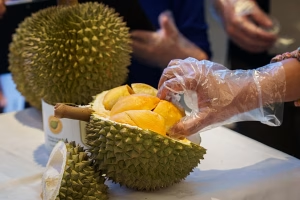
From Asia come two classic smell-based specialities: durian and stinky tofu. Durian is often dubbed the “stink fruit”, while stinky tofu lives up to its name. Both foods show that disgust often starts with smell, not taste. That first sensory impression often determines whether something is perceived as a delicacy or as an imposition.
Food as identity
The Disgusting Food Museum makes all this more than just a collection of bizarre dishes. The exhibition presents unusual foods from all over the world and wants visitors to question their own disgust threshold.
Anyone who wants to can sample items at the tasting bar, including edible insects. This is where the museum’s real appeal lies: disgust is not treated as a purely negative reaction, but as the starting point for a conversation about culture, habit and consumption. Alexandra Bernsteiner says many visitors come driven by curiosity, not just scepticism. Young couples and children are particularly keen to try things.
That fits with a simple insight: what seems alien to us today can, over time, become a fixed part of our diet. What one person finds inedible is, for someone else, a familiar dish steeped in tradition. Ultimately, our culinary preferences are also shaped by the resources we will have in future.